
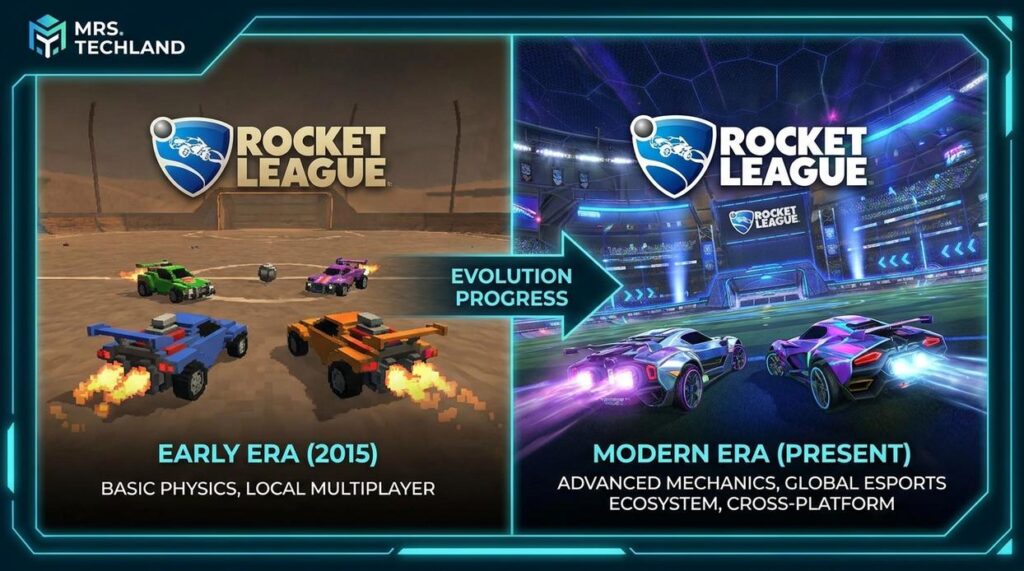
I’ve been playing Rocket League since the servers first went live back in 2015.
You’re probably here because you jumped into a match recently and got absolutely destroyed by someone doing things you didn’t even know were possible. Or maybe you’re coming back after a few years away and the game feels completely different.
It is different.
Here’s what happened: Rocket League started as a simple concept. Cars hit ball into goal. But somewhere along the way, it became something else entirely. Something way more complex.
I’ve logged thousands of hours in this game. I’ve watched mechanics get discovered, strategies get refined, and the entire community shift from casual chaos to calculated competition.
This article shows you how Rocket League has evolved from those early days of bumping into teammates to the technical showcase it is now.
We’re going to walk through the progression. The mechanics that changed everything. The strategies that emerged. The community that pushed the skill ceiling higher than anyone thought possible.
No nostalgia trip. Just the real story of how a game about car soccer became one of the most demanding competitive titles out there.
Whether you’re trying to understand what you missed or just want to see how we got here, you’ll get the complete picture.
The Humble Beginnings: When Hitting the Ball Was a Victory (2015-2016)
I still remember booting up Rocket League for the first time in 2015.
The concept seemed ridiculous. RC cars playing soccer? But within five minutes, I was hooked.
The beauty was in how simple it felt at first. Drive forward. Hit ball. Maybe score. That was the entire strategy for most of us (and honestly, it worked more often than it should have).
But then you’d miss. And miss again. And you’d realize this game had layers you hadn’t even considered.
Now, some people claim the early days were boring compared to what we have now. They say the gameplay was too basic and that modern mechanics are what make the game worth playing.
I disagree.
Those early matches had something special. Nobody knew what they were doing. We were all figuring it out together on the pitch.
The metagame back then? Pure chaos. You’d see players camping in goal while others just smashed into opponents for demos. Aerials were basically launching yourself at the ball and praying. Most shots came from ground dribbles or lucky bounces off the wall.
Then someone would pull off a clean aerial goal.
The whole lobby would stop. You’d see “Wow!” spam in the chat because we’d just witnessed something that felt impossible ten seconds earlier. It was like watching someone discover fire (except with a digital Octane and way more boost trails).
The community felt different too. You could whiff an open net and your teammate would just laugh it off. People experimented with weird strategies. I once played a match where both teams agreed to only go for ceiling shots. We failed miserably, but nobody cared.
That’s how rocket league has evolved mrstechland from a quirky indie game into what it is today. But back in 2015? We were just happy when the ball went in the right direction.
The Mechanical Revolution: How the Skill Ceiling Was Blown Wide Open (2017-2019)
Something changed between 2017 and 2019.
I’m not talking about small tweaks or minor improvements. I mean the entire game got turned upside down.
Some players will tell you the basics are all you need. That fancy mechanics are just for show. That if you master rotation and positioning, you’ll beat the flashy players every time.
And yeah, fundamentals matter. I won’t argue with that.
But here’s what those purists miss.
The mechanical revolution didn’t just add style points. It completely redefined what was POSSIBLE in a match.
Air Dribbles Changed Everything
Before 2017, the ball was mostly a loose object you tried to hit harder than your opponent.
Then air dribbles became consistent.
Suddenly, players could carry the ball through the air like it was on a string. You weren’t just hitting it anymore. You were controlling it, manipulating it, making defenders guess wrong over and over.
I watched this shift happen in real time. One season, air dribbles were highlight reel material. The next season, Diamond players were pulling them off in ranked matches.
The ball went from being a shared resource to being a weapon you could aim.
Walls Became Launchpads
The vertical game exploded during this period too.
Ceiling shots turned the top of the arena into an offensive tool. Wall play went from basic clears to complex setups that defenders couldn’t read.
Players started treating the entire box as playable space. Not just the ground. EVERYTHING.
I remember when hitting the ball off the wall was considered advanced. By 2019, players were chaining wall touches into ceiling resets into air dribbles. How rocket league has evolved mrstechland home tech from masterrealtysolutions shows just how far the skill ceiling stretched in such a short window.
Power Got Precise
The Kuxir pinch wasn’t new, but players started mastering it.
Same with power shots. It wasn’t just about hitting the ball hard anymore. It was about generating speed through angle and timing. Through understanding exactly where to make contact.
A well-executed pinch could send the ball at speeds that gave goalies maybe half a second to react. Sometimes less.
Training Packs Democratized Everything
Here’s the real kicker though.
Custom training packs meant you didn’t need to be a pro to learn pro mechanics. You could load up a ceiling shot pack and practice the same setup 100 times in 20 minutes.
Before training packs, you had to wait for the right moment in a real game to practice something specific. Now? You could drill any mechanic until your fingers hurt.
The skill gap between pros and committed amateurs started shrinking. Not because pros got worse, but because the tools to improve became available to everyone.
By 2019, mechanics that seemed impossible two years earlier were standard in Champion ranks.
That’s not evolution. That’s a revolution.
The Tactical Metagame: The Shift from Solo Plays to Team Synergy (2020-2022)

Between 2020 and 2022, something changed in competitive Rocket League.
The flashy ceiling shot montages? They stopped winning games at the highest levels.
Some players still argue that mechanics are everything. They’ll tell you that if you can’t hit flip resets and air dribbles, you’ll never make it to Grand Champion or SSL.
But the data tells a different story.
The Death of the ‘Ball-Chaser’
I watched this shift happen in real time. Players with insane mechanical ability started losing to teams with better coordination. Not sometimes. Consistently.
RLCS Season X showed us why. Teams like NRG and BDS didn’t win because they had the fanciest shots (though they could hit them). They won because they moved as a unit.
Individual skill became just one piece of the puzzle. You could be the best freestyler in the world and still get demolished by three players who understood rotations.
Perfecting Rotations
Back-post rotations became non-negotiable. If you weren’t rotating to the back post on defense, you were leaving gaps that good teams would punish every single time.
Here’s what separated the top teams:
- Boost management across all three players
- Maintaining offensive pressure without overcommitting
- Reading when to challenge and when to shadow
The best teams treated boost like a shared resource. When one player grabbed corner boost, their teammate adjusted. No wasted pads. No double commits on the same boost.
The Third Man Role
This is where how rocket league has evolved mrstechland really shows up in the numbers.
The third man stopped being just a defender. Players like Turbo and Kaydop redefined the role into something more like a quarterback. They read plays two steps ahead and set up their teammates instead of hunting goals.
Game sense mattered more than shot accuracy. A well-timed pass created better scoring chances than solo plays ever could.
From Demos to Bumps
Physical play got smarter too. Teams stopped going for random demos and started using calculated bumps to break defensive formations.
Watch any RLCS match from 2022. You’ll see bumps timed perfectly to open passing lanes or force rotation mistakes. It became a science.
The Modern Era: The Influence of Esports and the Push for Perfection (2023-Present)
Right now, if you’re playing Rocket League at any competitive level, you’re dealing with a completely different game than what existed even two years ago.
The skill ceiling keeps rising.
Some players complain that the game has gotten too mechanical. That you need thousands of hours in training packs just to keep up. They say it’s pushed casual players out and made ranked feel like a full-time job.
I hear that argument a lot.
But here’s what they’re missing. Understanding how the game evolved gives you a roadmap. You don’t need to master every mechanic. You just need to know which ones actually matter for your rank.
The flip reset changed everything. What used to be a flashy freestyle move became a legitimate offensive weapon. When you can reset your flip mid-air, you add a layer of unpredictability that forces defenders to second-guess every aerial challenge.
You get more scoring opportunities because opponents can’t read your next move.
The current meta revolves around speed. Not just hitting supersonic, but maintaining it through recovery mechanics like the speed-flip and wave dash. These techniques let you get back into position faster, which means fewer goals against you and more chances to capitalize on opponent mistakes.
Watch any RLCS match and you’ll see what I mean (the pros make it look effortless, but trust me, it’s not).
Here’s the interesting part about how rocket league has evolved mrstechland. Strategies from pro play filter down to ranked within weeks. A new rotation pattern shows up in the championship series, and suddenly you’re seeing it in Diamond lobbies.
You benefit from this trickle-down effect whether you realize it or not. Your teammates are trying these mechanics. Your opponents definitely are.
Knowing what’s coming next helps you adapt faster.
A Constantly Evolving Arena
I’ve watched Rocket League transform from basic ground plays to aerial acrobatics that seem impossible.
You came here to understand how the game got to where it is today. Now you see the full picture.
Knowing this history isn’t just interesting background. It explains why players approach the game the way they do right now. Every mechanic you see in competitive play has roots in someone’s creative breakthrough.
The players drove this evolution themselves. That’s what keeps Rocket League fresh after all these years.
Here’s the thing: the skill ceiling still looks endless. Someone out there is probably working on the next game-changing technique right now. That’s what makes this game special.
How Rocket League has evolved mrstechland shows us that innovation never stops. The community keeps pushing boundaries.
Stay curious about new mechanics. Watch how top players adapt. Try things that seem crazy (they might work).
The next breakthrough could come from anywhere. Maybe even from you.
